🎉 Double your calls in 2026!


What Is Local SEO Services? [2026 Guide]
Written by:

Surmarketing
|
Updated on November 16, 2025
|
Reading Time: 10 minutes
|
What Is Local SEO Services?
If you run a local business in 2025, you’ve probably felt at least one of these:
• Ads keep costing more.
• Lead resellers eat your margins.
• Big brands somehow show up ahead of you, even though they’re nowhere near as local as you are. In the middle of all that, there’s one thing almost every buyer does before they choose a company:
They open Google and search for something like “plumber near me,” “roof repair in city,” or “pest control open now.”
Local SEO is the work that decides whether you show up in those moments—or whether the job goes to someone else.
This guide breaks down what “local SEO services” actually means in 2025, what’s included when an agency offers it, and how it helps your business grow in a way that lasts longer than a one-month ad campaign.
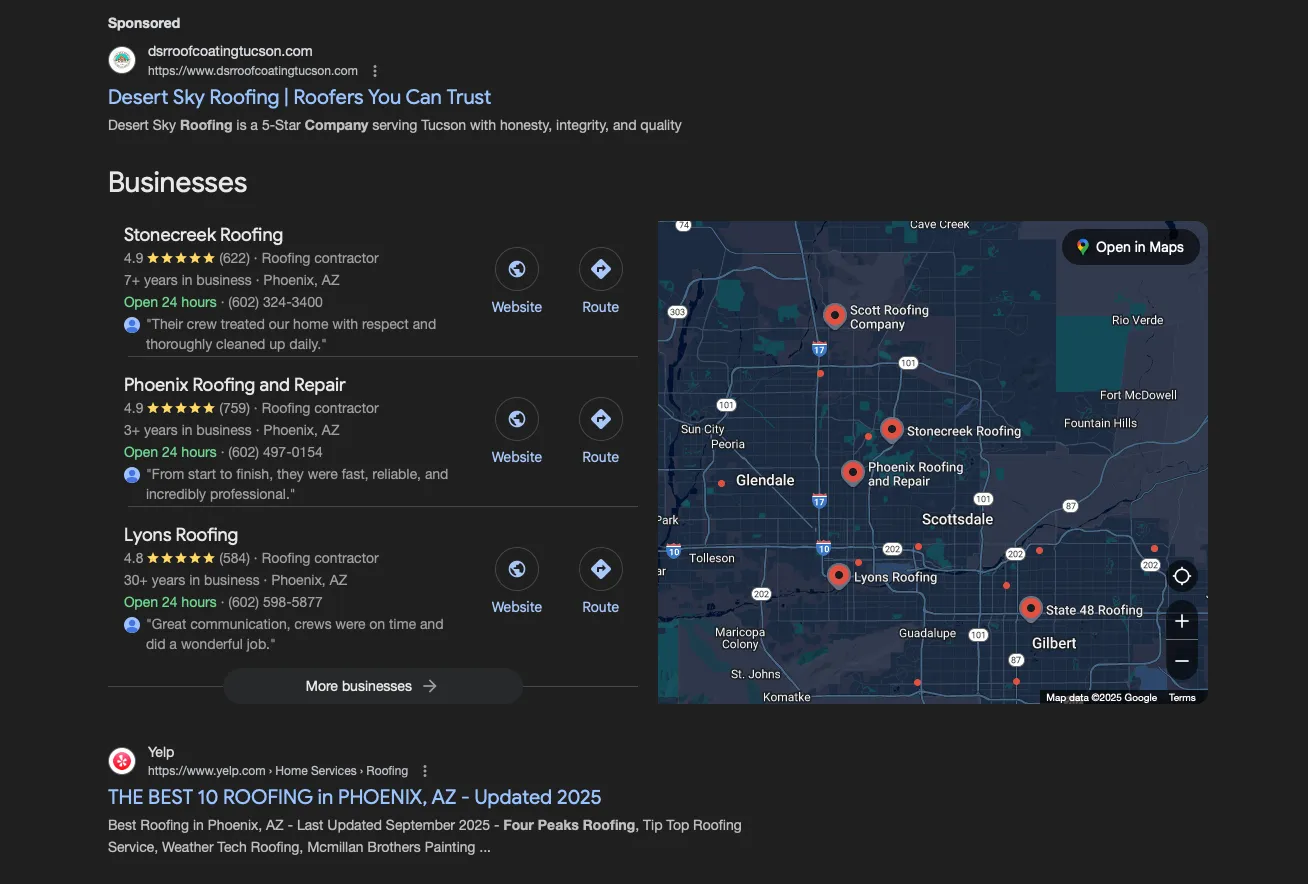
What is local SEO?
Local SEO is the process of making your business easier to find in location-based searches.
That usually means three main places:
- Your Google Business Profile (GBP) in Google Maps and the “local pack”
- Your website in local organic results (the standard blue links)
- Your business details across directories and listings (like Yelp, Apple Maps, Bing, Facebook, local sites, etc.)
When someone nearby searches for a service you offer, Google tries to answer three questions:
- Is this business relevant? Does it clearly provide what the person is looking for?
- Is it close enough? Is it in a location that makes sense for this search?
- Can we trust this business? Does it have reviews, mentions, and signals that show it’s active and reliable?
Local SEO services are simply the work of improving those signals in a consistent, methodical way.
How is local SEO different from “regular” SEO?
Standard SEO usually focuses on broad, non-location specific searches:
“how to fix a leaky faucet”“best flooring materials for kitchens”“garage conversion ideas”
Those searches might be handled by blogs, guides, or national brands. The location doesn’t always matter. Local SEO zooms in on who is searching and where they are:
“emergency plumber near me”“roofer in city”“HVAC repair open now city”
A few big differences:
• Local intent matters. Google uses different systems and signals when it thinks the user wants a nearby business, not just an answer.
• Maps visibility is huge. The “local pack” and Google Maps are often more valuable than a regular blue link.
• Business data is a ranking factor. Your address, phone number, category, hours, and reviews aren’t just contact info—they’re part of the ranking system.
• Content still matters, but in a different way. You still need good pages and helpful content, but local relevance and service areas often matter more than pure blog volume.
So when you see “local SEO services” on an agency site, you’re not buying generic content or random backlinks. You’re paying for someone to tune all the things that tell Google:
“This is a real local company, in this area, doing this work, with this reputation.”
Who are local SEO services for?
Local SEO is especially useful if:
- You serve customers in a specific area (city, county, cluster of suburbs)
- People often find your service with phrases like “near me,” “in city,” or “closest service”
- You want calls, form submissions, quote requests, or bookings from people who live or work nearby
Examples:
- Home services: HVAC, plumbing, electrical, roofing, landscaping, tree care, pest control, remodeling, cleaning
- Transportation: movers, towing, local delivery
- Personal services: salons, dentists, physical therapists, gyms, photographers
- Local retail or “visit-us” businesses: coffee shops, restaurants, boutiques, auto repair
If you depend on local trust and local intent, local SEO is usually not optional—it’s central.
What do “local SEO services” actually include?
Different agencies package this work in different ways. Under the hood, though, most real local SEO campaigns touch the same core areas.
Let’s walk through them in plain language.
1. Local market and keyword research
Good local SEO starts by understanding:
• What people in your area actually search for
• How they phrase those searches
• Which nearby businesses already show up for them
An agency will usually:
• Look at your current rankings, competitors, and service areas
• Find phrases that combine service + location (e.g., “water heater repair city”)
• Separate urgent searches (emergency, same-day) from planned searches (remodel, maintenance, seasonal work)
The point isn’t to chase every keyword. It’s to figure out which phrases are most likely to turn into calls and booked jobs for you.
2. Google Business Profile setup and tuning
Your Google Business Profile is often the first thing someone sees before your website.
Local SEO services almost always include:
• Making sure your profile is claimed and verified
• Choosing the right primary and secondary categories
• Adding accurate name, address, phone number, hours, and service areas
• Writing a clear business description
• Uploading real photos (work, crew, vehicles, before / after)
• Adding services and common questions / answers
• Posting regular updates (offers, reminders, recent projects, seasonal notes)
For a lot of local businesses, simply cleaning this up and keeping it active delivers a noticeable bump in calls—especially if the profile was half-empty before.
3. On-page and website improvements
Your website doesn’t need to be fancy. It does need to answer basic questions quickly and clearly:
• What do you do?
• Where do you work?
• Who do you help?
• How do people contact you?
Local SEO work on your site usually includes things like:
• Creating or refining service pages (one page per main service, not one page trying to cover everything)
• Adding location pages for key cities or neighborhoods, where it makes sense
• Updating page titles, headings, and meta descriptions so they match how people search
• Making sure your site loads quickly and works well on a phone
• Cleaning up broken links, sloppy internal links, or confusing structure
The goal is simple: when someone lands on your site from a local search, they shouldn’t have to guess what you do or hunt for your number.
4. Local citations (your business listed consistently everywhere)
A “citation” is just a mention of your business’s name, address, and phone number on another site.
Think:
• Google
• Apple Maps
• Yelp
• Bing Places
• Facebook
• Industry-specific sites
• Local chamber / directory listings
Local SEO services usually include:
• Finding your existing listings and spotting inconsistent or outdated info
• Fixing typos, old addresses, wrong phone numbers
• Adding your business to strong, relevant directories you’re missing
Why it matters:
If Google sees three different addresses, two spellings of your name, and an old phone number spread around the web, it hesitates. Clean, consistent citations help it trust that you are who you say you are and work where you say you work.
5. Reviews and reputation support
Reviews do two things at once:
1. They help your rankings in the local pack and Maps
2. They heavily influence who gets the call once someone sees a list of options
Local SEO services often help you:
• Build a simple process for asking happy customers to leave a review
• Decide which platforms to focus on (GBP first, maybe others second)
• Respond to reviews in a way that shows you’re paying attention
• Deal with the occasional unfair or angry review without panicking
You don’t need hundreds of reviews overnight. You need a steady trickle of honest, specific feedback that keeps your profile fresh.
6. Local link building
Backlinks—links from other sites to your site—still matter for ranking.
For local businesses, some of the best links often come from:
• Other local businesses you partner with
• Local news features or community sites
• Sponsorships (youth teams, charity events, neighborhood gatherings)
• Industry associations or supplier directories
Local SEO services might include:
• Identifying realistic link opportunities in your area
• Reaching out to partners or organizations where a link makes sense
• Updating existing mentions of your business so they actually link to your site
This isn’t about buying spammy links. It’s about building real connections and making sure search engines can see those connections.
7. Local content that actually helps
You do not need a blog just to have a blog.
Good local content is the kind of material that:
• Answers questions your customers genuinely ask
• Helps people decide what to do next
• Reflects your area, your climate, your building styles, your seasonality
Examples:
• “Roof repair after hail in region: what insurance usually covers”
• “How often to service your AC in city’s climate”
• “When to call a tree service after a storm vs. when to wait”
• “Checklist: getting ready for a long-distance move from city”
Local SEO services might include planning, writing, and publishing this kind of content, then tying it back to relevant services and locations.
8. Tracking, reporting, and adjustments
Local SEO is not a “set it and forget it” task.
A good local SEO service will:
• Track rankings for your main search terms and areas
• Monitor calls, form fills, and quote requests that come from search
• Watch how your Google Business Profile is performing (views, actions, etc.)
• Spot which pages or areas are gaining traction and which need more support
The report you see each month should feel like a story, not just a spreadsheet:
• Here’s what we did
• Here’s what changed
• Here’s what we’re doing next based on those results
9. 2025 extras: live job maps and activity signals
One newer piece of local SEO in 2025 is automated activity and job mapping.
Tools like Spotlight (what we build for contractors) let your crew:
• Log a job at the address
• Attach a quick description and photo
From there, the system can:
• Create a Google Business Profile post with location context
• Drop a pin on a job map on your site so visitors can see where you’ve worked
• Add ongoing, geo-tagged content that tells Google, “we are active in these areas doing this work”
Local SEO services that include this kind of automation can keep your presence fresh without asking you to write posts all day.
How local SEO works under the hood: relevance, distance, reputation
Google has never shared the full recipe, but for local results it has been clear about the three main ingredients:
- Relevance Does your profile and website match what the person is searching for? If someone types “heat pump repair,” and you only talk about “HVAC services” in a vague way, you may show up less often.
- Distance How close are you to the person searching, or to the area named in the search? This is why service areas, address accuracy, and clear local language matter.
- Prominence (reputation) Do you have reviews, links, mentions, and a visible track record online? Are you active, or does your business look abandoned?
Local SEO services are simply structured ways to improve relevance, clarify distance, and strengthen your reputation over time.
What results should you expect—and how long does it take?
No honest guide can give you a universal timeline, but you can think of it roughly in phases.
Months 1–3: foundation and fixes
• Cleaned-up Google Business Profile
• Better service pages and location pages
• Citation cleanup and basic local listings
• First waves of review requests
What you might notice:
• More views and actions on your GBP
• Some movement for less competitive search terms
• Early increases in calls, especially if your profile was messy before
Months 3–6: growing visibility and leads
• More consistent posting and content
• More reviews coming in
• Stronger rankings in your closest service areas
• First local links and mentions
What you might notice:
• More calls and form fills from search
• More “we found you on Google” comments
• Increasing appearances in the local pack for your home market
Months 6–12 and beyond: expansion and stabilization
• Targeting additional neighborhoods or cities
• Refining content around high-value services
• More consistent presence in the top positions for your main searches
What you might notice:
• Search becomes a reliable source of new work
• You can make clearer decisions about which areas to grow into next
• You feel less exposed to paid leads and rising ad costs
Local SEO doesn’t pay off in a week. But for many local businesses, a year of steady work can completely change where their leads come from.
Should you hire local SEO services or do it yourself?
You can do a lot of local SEO on your own:
- Claim and fill out your Google Business Profile
- Ask customers for reviews
- Fix obvious mistakes on your site and listings
This is a good idea whether you hire help or not.
Hiring an agency or specialist usually makes sense if:
- You want faster progress and less trial-and-error
- Your market is competitive (lots of similar businesses in the same area)
- You don’t have someone in-house who can own this consistently
- You’re ready to treat search as a core growth channel, not a side project
The key is to find a partner who:
- Shows you what they’re doing and why
- Talks in plain language, not just jargon
- Connects the work to calls, booked jobs, and revenue, not just rankings
Common questions about local SEO services
1. Do I really need local SEO if I get word-of-mouth referrals?
Referrals are gold, but many people still Google you before they call. If they see an empty profile, two reviews from 2019, and a slow site, that referral can quietly disappear.
2. Is local SEO just updating my Google Business Profile?
That’s part of it, but not the whole picture. Your profile, your website, your reviews, your citations, and your local links all work together. Ignoring any one of them for too long can hold you back.
3. Can anyone guarantee a #1 ranking in Maps or local search?
No one can guarantee that honestly. Local SEO is about increasing your chances to show up well across many searches and areas—not locking in a permanent #1 spot.
4. How is “local SEO services” different from buying leads?
With lead sellers, you’re renting attention. When you stop paying, the leads stop. With local SEO, you’re building your own visibility so people contact you directly—no middleman, no per-lead fees.
5. Is local SEO still worth it with AI changing search?
Yes. AI still needs strong local data, real websites, and clear profiles to pull from. The businesses with the best local signals will be the ones AI features, cites, or shows alongside summaries.
Where to go from here
f you’ve read this far, you probably don’t need to be convinced that local search matters. You’re more likely wondering:
“What should my business do first, and what’s realistic for my market?”
That’s where a tailored plan helps.
At SurMarketing, we work specifically with local, service-based businesses—contractors, home services, and trades who rely on Google searches, Maps, and reviews to keep crews busy.
If you’d like to see what local SEO services could look like for your business in 2026, we can walk through:
- Your current visibility in search and Maps
- Your competitors’ presence
- The fastest wins and realistic next 6–12 months
No fluff, no magic tricks—just a clear look at where you are and what it would take to grow.
Ready to explore local SEO services for your business?
Share a few details about your company, and we’ll map out a practical, numbers-based plan for strengthening your visibility and turning more local searches into booked work.